Sunday, 27 January 2013

There's An App For That!

The Sunday Times has published the first in a series of App Lists today, sharing ideas for apps of all kinds. I have just installed two that give a great insight into fashion and knitwear.

The Sunday Times App List Supplement
Vogue Daily News (iPhone, Android, Blackberry: Free) has a round up of what's going on in the Vogue World. Todays news section has an article on Christian Wijnant and his nomination for the International Woolmark Prize. Wijnant is working with one white merino yarn to explore shape, stitches and dyeing processes. The International Woolmark Prize of $100,000 AUD will be announced after the regional winners show their collections to the judging panel at London Fashion Week.

Headline from Vogue News website
Tokyo Fashion (iPhone, Android, Windows Phone: Free) has an ever changing set of street style images from Tokyo. A search for 'knitwear' brings up some interesting designers who showed at the Mercedes Benz Fashion Week in Tokyo last year. Yasutoshi Ezumi's biography highlights his links to Central St Martins and Alexander McQueen. The photos of his Autumn/ Winter 2012-13 knitwear collection are full of fabulously draped cables.

Logo from Tokyo Fashion website


Friday, 18 January 2013

London Collections: Men, Knitwear Highlights

Inspirational design was on show throughout London Collections: Men, 7th to 9th January 2013, with previews of the trends for Autumn/ Winter 2013. Here are my knitwear highlights.

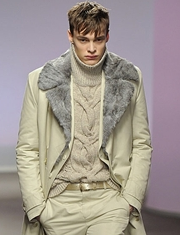
Topman Design: polo neck and crew neck sweaters and belted jackets were bold in colour, cable or texture. Hand warmers are knitted as part of the sweater to keep the wearer extra warm!


(All images from the British Fashion Council London Collections Website. Click on the links to view the full designer collections.)


Hackett London had a wonderful selection of elegant fair isle waistcoats, sweaters cardigans and scarves worn with traditional jackets.


Nicole Farhi  combined patterns of different scale to create bold, fitted sweaters and cardigans. Handwarmers knitted as part of the sweater were also part of this collection.


Margaret Howell used modern updates of traditional styles.


YMC used matching scarf and sweater sets, combinations of different patterns,  chunky argyll diamonds and side neck openings as features in the garments.


Richard James showed stylish sets of hat, scarf and gloves with either smart coats and jackets or the matching sweater.


Christopher Shannon's bold combinations of graphic or cable knits were really 'eye-catching'.


Sibling went oversize in every way!


James Long combined patterned knitting as sleeves for waistcoats or the body of jackets.


Shaun Samson included oversize knits with combinations of cables and colour.


Sunday, 13 January 2013

Valentino: Master of Couture

The Valentino exhibition at Somerset House, London shows Couture design at it's best: attention to detail, high quality materials and strong vision. Entry to the Exhibition in the lower galleries is down a dramatic stairwell, 'dressed' with this beautiful drape of red fabric.

Beautifully draped fabric in Somerset House stairwell.
Photo by Emma Vining
The exhibition begins with a vibrant table top projection, followed by a selection of design sketches and show invitations cards displayed in cases below wall projected images in the shape of a huge flower. Stairs lead you up to 'The Catwalk', where mannequins model the couture garments on both sides of the gallery.

The Catwalk
Image from Somerset House Website
Each garment is identified by a number, with detail in the accompanying guidebook. Highlights for me included the origami technique in garment No 12, S/S 2008, a pale pink taffeta ensemble with detailed folding; the overlaid sequin swirls on the sleeves and jacket on garment No 19, S/S 2005, a black shantung silk suit; huge circular crochet-like embellishments on garment No 20, a black and white tweed ensemble. Throughout the catwalk, the garments showed off the expert use of lace, pearls, crystal, sequins, pleating, folding and fabric manipulations.

Following the catwalk is a top down view of Princess Marie Chantal of Greece's wedding dress with the huge train spread out. This dress illustrates the level of detail and craftsmanship that goes into every creation as it took 16 people 6 weeks just to create the lace veil. Further insights are revealed in the next room where some of the techniques used are demonstrated on screens embedded in a huge table accompanied by actual samples.

Image from Somerset House Website
This inspiring showcase of 50 years of Valentino through over 130 dresses and insights into haute couture techniques runs until 3rd March 2013 at Somerset House, London.


Sunday, 16 December 2012

Dreaming In Colour: Kaffe Fassett at the V&A

Kaffe Fassett is a very busy man, with an exhibition at the Fashion and Textile Museum in March 2013 and two new books on the way. This is how Kaffe Fassett was introduced at the beginning of a very entertaining interview with Paul Allen at the V&A on Friday 14th December, based on his autobiography, Dreaming in Colour.


Kaffe moved to the UK from Big Sur, California, in 1964. Although already a successful artist, he had always been intrigued by textiles. His discovery of hand knitting began when visiting a mill with the designer Bill Gibb. By chance, Kaffe discovered beautifully coloured hand knitting yarns at the mill that captured the essence of the landscape he had just been travelling through. He immediately bought 20 different shades of yarn and then had a 20 minute lesson in hand knitting with a lady he met on the train on the way back to London. From then on, everything he encountered became a knitting possibility!

Working very quickly, with great focus has been key to Kaffe's colour developments. If a swatch is not turning out as expected, he keeps knitting and corrects as he goes, constantly looking at what he has knitted and changing what needs to be changed to balance the colours. He describes the process as making a painting in yarn.

From Christmas packaging for M&S developed from a needlepoint of brilliant, vibrant flowers, to a beautiful hollyhock mosaic at the front door of his studio made from (deliberately!) broken crockery, Kaffe has always been inspired by flowers and gardens. It was therefore very appropriate that the interview ended with this photograph of a fabulous rose, which Brandon Mably has arranged to have named 'Kaffe Fasset'. A dramatic, bold and colourful finish to an excellent interview!
Kaffe Fassett and Paul Allen in conversation at the V&A

Friday, 7 December 2012

Kaffe Fassett and Colour Inspiration

There is one week to go until the Kaffe Fassett talk at the V&A, when he will talk about 'his career, recent projects and his passion for colour'. Kaffe Fassett has always used colour creatively throughout his designs and across many different art and craft disciplines. Thinking about his clever colour combinations, I looked through his many patterns in my Rowan Magazines and other pattern books for colour inspiration. I then got out my Kaffe Fassett 'sweater in a box' kit by Rowan yarns, which is made with 23 stunning colours.
Section of Bright Diagonal Box Stripe Sweater (1989) by Kaffe Fassett and Zoe Hunt
Knitted by Emma Vining
As well as the multicoloured little 'boxes', the knitted diagonals in this sweater have additional colour changes within them and are never just one solid colour. These small details make you look twice and are typical of Kaffe Fassett's approach to colour. The only downside is the number of ends to weave in!
Kaffe Fassett's new autobiography 'Dreaming in Colour' is on my Christmas list and I'm looking forward to being even more inspired by next week's talk.


Tuesday, 27 November 2012

Free Form Crochet Inspiration

A stunning crochet dress from the 1967 film, Camelot is a wonderful inspiration for freeform crochet. Worn by Vanessa Redgrave as Guinevere, the dress is on show as part of the Hollywood Costume Exhibition at the V&A. Looking closely at the dress, you can see why designer John Truscott won the 1967 Academy Award for best costume design.
Vanessa Redgrave as Queen Guinivere, Camelot, 1967

Described as being made from wool, silk and pumpkin seeds, most of the dress is made of 'finely crocheted woollen spider webs' that are laid over silk. At the centre of some of the 'webs' are tiny shells and behind them are hints of metallic crochet. Pumpkin seeds were dried then stitched to the silk train of the dress.
Pumpkin seed detail on Guinevere Dress
Crochet detail on Guinevere Dress
Crochet samples based on Guinevere Dress


Friday, 16 November 2012

Knitting: Fashion, Industry, Craft


Introducing her new book, Knitting: Fashion, Industry, Craft, in a lecture at the V&A on Thursday 15th November 2012, Professor Sandy Black began by asking the question, 'What is knitting?'

Using the four sections of her book to answer the question, Sandy showed us how she had been inspired by the V&A Collections. Here are some of my highlights.
Part One: The Origins of Knitting, 3rd Century to late 19th Century. 
Knitting can be said to have begun with heads, hands and feet! Sandy showed us several examples including Coptic socks found in Egypt , Tudor caps from London and ornate silk stockings for men, before moving on to a stunning 17th Century boucle jacket. The highlight of this section for me was an 18th Century item, the 'Dutch Petticoat'. The origins of the mechanisation of knitting began with William Lee's knitting frame in 1589.
Coptic Socks (source: V&A)
Part Two: Livelihood and Industry in Hand and Machine Knitting, 17th - 21st Century. 
During this time period, whole families knitted to supplement incomes. Knitting was taught in schools and workhouses to 'keep idle hands busy'. Detailed instruction manuals containing tiny examples of knitting were used at this time. During the early 20th Century Fair Isle knits became a fashion classic when worn by the Prince of Wales and Dr Jaeger began his business with 'hygienic' socks featuring separate toes. Couture knitting in the postwar period was illustrated by the Maria Lick Szanto designs (a review of Sandy's talk on the Szanto designs appears in an earlier post).
Instruction Book (source:V&A)
Part Three: Knitting in the Home from the 18th Century to present. 
Knitting patterns gradually became more widespread and Sandy showed us some lovely examples from Welsons in the 1890s, Woolcraft in the 1920s and Patrons & Baldwins in the 1930s. The radical changes in home knitting were shown by examples from sportswear, WWII knitting, 1950s glamour knitting, home machine knitting through to Freddie Robbins' Odd Gloves. 
1940s Knitting Pattern (source:V&A)
Part Four: Classics to Couture 1900 to Now. 
Over this period, knitting has constantly moved in and out of fashion, from the Polka jackets of the mid 19th Century, Chanel and Schiaparelli designs of the 1920s through Bill Gibb and Kaffe Fassett to Biba and Missoni and on to Kenzo, Sonya Rykiel, Mark Fast and Peter Pillotto to name only a few. Using these examples and more, Sandy took us on a rapid journey through the engineering possibilities of knitting.
Missoni Knitted Dress (Source: EV photo)
So, was the opening question, 'What is knitting?' answered? It certainly was and in such detail and in so many interesting ways that I cant wait to read even more in the book itself!