Thursday, 21 January 2016

Yarn Stories Top Five Patterns for 2015

What a fantastic start to my knitting year! Yarn Stories have announced that my Spinnaker sweater design was their most popular pattern in 2015! I loved designing and knitting this sweater and am delighted that Yarn Stories customers like Spinnaker as much as I do.

Spinnaker by Emma Vining for Yarn Stories

Here is the most recent newsletter from Yarn Stories with all of the top five patterns. You can sign up for future newsletter updates on the Yarn Stories website.


Our most popular patterns of 2015
Here is a countdown of our most popular patterns of 2015. Read on to find out which patterns you liked the most...
No.5
Barkentine
At number 5 is this  easy to wear sweater with casual drop shoulders and a delicate lace pattern. It's surely why this design was so popular.


Construction Method: Knit
Designer: Carol Fella
Required Yarn Thickness: dk
Skill Level: Growing In Confidence
Shop now
No.4
Hellador
Cables were huge trend in knitwear for the latter half of 2015 and Nick's heirloom shawl has got plenty of them.


Construction Method: Knit
Designer: Nick Atkinson
Required Yarn Thickness: dk
Skill Level: Growing In Confidence
Shop now
No.3
Shingle
It was no surprise to us when we saw this adorable cardigan in the top five. Sue's designs for children are always very popular and this one was most beloved of all.

Construction Method: Knit
Designer: Sue Batley-Kyle

Required Yarn Thickness: dk
Skill Level: 
Growing In Confidence
Shop now
No.2
Banyan
Amanda's design captured the essence of summer at the seaside with mini cables that resemble ropes and a pretty peplum for an extra feminine feel.


Construction Method: Knit
Designer: Amanda Crawford
Required Yarn Thickness: dk
Skill Level: Growing In Confidence
Shop now
No.1
Spinnaker
 Spinnaker proves that even the most difficult patterns don't put you off! However this is totally understandable; the cables, twisted stitches and moss stitch texture in Emma's design are gorgeous.

Construction Method: Knit
Designer: Emma Vining
Required Yarn Thickness: dk
Skill Level: I'm Feeling Brave
Shop now
Copyright © 2016 Spectrum Yarns Ltd, All rights reserved.

Wednesday, 20 January 2016

Patternity: A New Way of Seeing

At the V&A museum on Friday evening, the design consultancy Patternity showed their audience "a new way of seeing" in their fascinating presentation on the inspirational power of pattern. Surface designer Grace Winteringham and art director Anna Murray set up Patternity in 2009 with the aim of using pattern as a tool to inspire.

Anna and Grace in Conversation with Dal Choda
The Patternity design philosophy is to find pattern absolutely everywhere. Beginning with the urban landscape on their way to work, Anna and Grace have built an archive of often hidden pattern with fascinating visual linking. Patternity is now a source of inspiration for many major brands and companies.


During the evening, we saw many of the beautiful images that can be found on the Patternity website in the amazing archive.

Images by Patternity
Using their own trademark Patternity pattern, Grace and Anna have also designed bespoke items such as body pattern tights, garments and accessories. 

Patternity tights
Images by Patternity
Anna and Grace have recently published a beautiful book and are very excited about becoming even more involved in events and educational activities. In a previous post, Pattern Power, I wrote about an inspirational exhibition that they curated in 2013. They aim to continue to spread the word about pattern through these kind of events and to expand the worldwide network of pattern collaboration that they have built up over the last few years. I can't wait to see what Grace and Anna do next!

Thursday, 24 December 2015

Fenchurch Cardigan in the Knitter Issue 93

My copy of The Knitter Magazine has arrived and I am over the moon to see my Fenchurch Cardigan on the front cover! The stunning photos by the Knitter Magazine show the bold lines and texture of my design in beautiful detail.

Fenchurch Cardigan by Emma Vining
Photo by The Knitter Magazine 
Fenchurch is inspired by modern urban architecture. I have used wrapped stitch ladders to create bold lines. I love the way the wrapped stitch sections change the shape of the cast on edge at the beginning of the panels. The textured sections are knitted in moss stitch. To keep the tension of the sections even, the moss stitch section is worked in short rows. 

Fenchurch Cardigan by Emma Vining
Photo by The Knitter Magazine
I particularly like designing (and knitting!) cardigans where the button band is knitted as part of the fronts and Fenchurch fits the bill with this integral moss stitch band. Shaping for the neck is worked in a line of decreases that follow on from the first wrapped stitch ladder. This enhances the wide neckband and the moss stitch upper body.

Fenchurch Cardigan by Emma Vining
Photo by The Knitter Magazine 
The optional belt features two wrapped stitch ladders with a moss stitch centre section. The cuffs are made in a similar way and added after the sleeves are complete.

Fenchurch Cardigan by Emma Vining
Photo by The Knitter Magazine
Fenchurch is knitted in Cascade 220 Aran, 100% Peruvian Highland wool. The lovely blue shade is Marine, 8339. 

Thursday, 10 December 2015

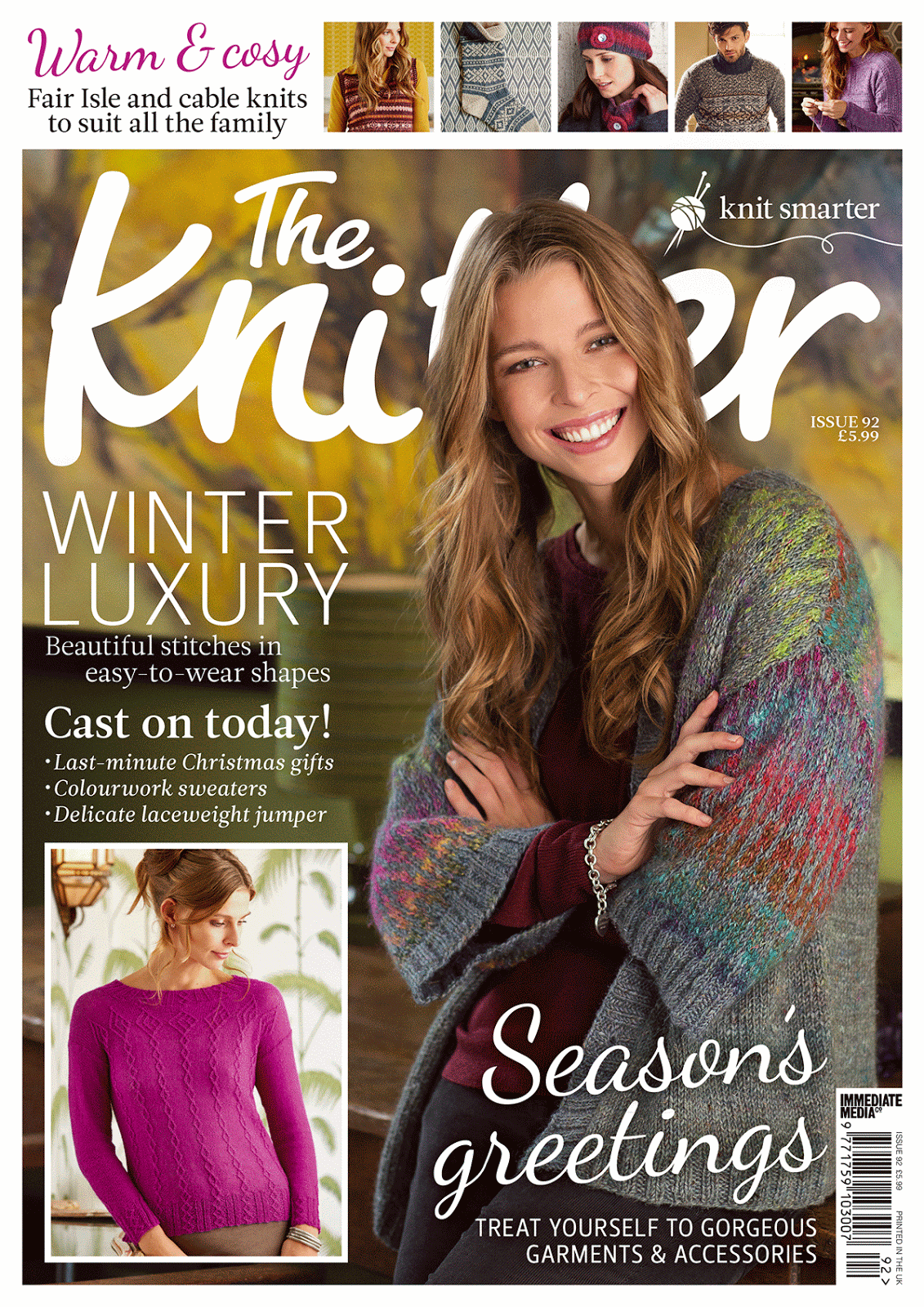
Diamond Kites Sweater in The Knitter, Issue 92

Issue 92 of the Knitter Magazine includes my Diamond Kites Sweater pattern! Knitted in Artesano Alpaca Silk Lace yarn, Diamond Kites has a delicate twisted stitch pattern. The beautiful photos show the sweater in lovely detail. Thank you very much to The Knitter Magazine.

Diamond Kites Sweater by Emma Vining
Photo from the Knitter Magazine
Little twisted stitch diamonds form the long "kite tails". They lead up to the "kite head" that is made of three interlocking diamonds, again knitted in twisted stitches. The back of the sweater is longer than the front and the sides are open to the top of the rib section.

Diamond Kites Sweater by Emma Vining
Photo from the Knitter Magazine
The beautiful Artesano Alpaca Silk lace yarn is available in a wide range of gorgeous shades. I have used Colour 2083, "Aubergine" for Diamond Kites. The knitted fabric with the twisted stitch design in this combination of alpaca and silk has lovely drape and is very flattering to wear.

Diamond Kites Sweater on the Cover of Issue 92!

Errata update 14/12/15
There is an errata for the pattern published in Issue 92.
A couple of symbols were missed out of the abbreviation list and the sleeve cast on has been updated. Please follow this link to the Yarn Loop website for the updates. Thank you.

Sunday, 6 December 2015

Knitting: Stitch-Led Design by Alison Ellen

Exciting news! Alison Ellen has released a new book! Knitting: Stitch-Led Design is an inspiring read with ideas and projects for knitters of all levels. Published by Crowood Press, the book is available to buy direct from Crowood, where you can also take a "peek" inside the book. 

Alison Ellen's new book
Published by Crowood Press

"This book encourages you to look beyond ready made knitting patterns and to explore as new the creative potential of this strong textile structure that we are all so familiar with. It looks in minute detail at how stitches can change the character of the knitted fabric, using even the simplest combinations of knit and purl to alter the surface, feel and drape." This quote from the inside cover perfectly describes the first part of Alison's book.

I particularly like the"Comparing Stitches" Chapter where Alison demonstrates how different stitches affect the knitted fabric . She has included a "baseline" sample on each page to clearly show the differences. Understanding how knitting stitches behave at this detailed level is the key to designing and making interesting and original knitwear. 

The chapter on "Shaping" is an excellent resource for exploring 3D form and knitted fabric manipulations. I have had first hand experience of some of the samples in this section as my knitting group, Teresa, Maggie, Sue, Rosemary, Joy, Kim and I, helped to test knit a selection. I am also very proud and absolutely delighted that Alison has included one of my designs in her book. My Points scarf pattern illustrates how increasing and decreasing can create 3D form. Knitted in Debbie Bliss Cashmerino, the scarf looks great worn long or wrapped around to show off the 3D patterning.

Points Scarf by Emma Vining
in Knitting: Stitch-Led Design by Alison Ellen
Photography by Colin Mills
The "Techniques" Chapter includes the information you need to make the gorgeous designs included in the last Chapter, "Projects". Beautifully photographed by Colin Mills. the garments and accessories have clear and informative pattern and yarn notes. The projects range from lovely hats, bags, scarves and small accessories that use the techniques demonstrated earlier in the book, to some of Alison's most beautiful designs, such as her Modular Jackets and my favourite jacket, "Broken Blocks". You can see Alison's design Collection on her website, Alison Ellen Hand Knits.

Looking in detail at Alison's designs in Knitting: Stitch-Led Design, you can really appreciate the clever thought behind each garment, along with the stunning combination of yarn shades she has selected. In each project, the stitch pattern and garment shaping relate really well together. The end result is beautiful garments and accessories that are a pleasure to knit. 

"Written by a passionate and innovative knitter, Knitting-stitch-led design pushes ideas and boundaries to encourage creative thinking and confidence in experimenting. It promotes a different approach to designing and explores how stitches work, always asking the question 'what would happen if....'" This quote from the book cover is spot on and sums up why I find Alison's approach to design so inspiring. I thoroughly recommend this gorgeous book for all the excellent advice and encouragement for knitters to experiment with their knitting.

You can read more about Alison on her website and there is an interesting interview with her on the Knitting & Crochet Guild website too.

Monday, 30 November 2015

Fair Isle Knitting with the London K&C Guild

The London Branch of the Knitting & Crochet Guild met this Saturday afternoon and the extremely talented Mary Henry presented an excellent Fair Isle workshop. There was so much to learn about this most "traditional" of techniques, from the beautiful symmetry of colour and stitch in each design to the most practical ways to manipulate two colours on one row. 

Fair Isle knitting by Mary Henry

Mary had brought along some of her own garments to illustrate techniques. As well as being beautiful on the outside, each garment was stunning on the inside with the floats having the same symmetry as the design. 

Fair Isle knitting by Mary Henry
Mary demonstrated the usefulness of a camera phone to work out colour combinations. Taking a photo in colour then changing it to black and white shows the difference between hue and saturation. This can make all the difference when selecting multiple shades for a complex design.  

Colour Shade card

The same shade card in b&w

We had a lively discussion about techniques for steeks! Mary had brought a swatch with her and showed us one technique that uses crochet to secure the edge stitches. Mary used a contrast yarn to crochet two lines of stitches on either side of the stitches to be cut. Then, with much trepidation for some of us, we all got the chance to cut the steek!
Crochet edges in progress

Crochet edges in progress

Partially cut steek

Philippa Thomas joined Mary to talk about machine knit fair isle. It was extremely interesting to hear about Philippa's lovely designs and how her design process changed over time. 


Fair Isle Knitting by Philippa Thomas
There was time to try some of the Fair Isle techniques and I particularly enjoyed trying out corrugated ribbing. Reversing the colourways changed the look of the ribbing and although I ran out of time to test this fully in the meeting, I did finish the swatch on the train home!

Fair Isle sample in progress by Emma Vining

The next K&C Guild London branch meeting will be on 6th February 2016 and will feature Jennie Atkinson on "Sparkle: The Art of Beaded Knitting". All are welcome to come along, members £10, non-members £15.  More information on the K&C Guild and the London Branch can be found on the Guild website

Thursday, 19 November 2015

Knitting History Forum AGM and Conference 2015

The Knitting History Forum (KHF) Conference was held at the London College of Fashion on Saturday 14th November. This excellent afternoon covered knitting history topics from "Gunnister Man" to "Medieval knitting in Spain". Our speakers shared their in-depth knowledge and passion for their subjects and left us wanting to discover more! Thank you to Professor Sandy Black and the KHF committee for such an interesting Conference and thank you to all the speakers for their wonderful presentations.

Pence Jug by Sally Kentfield

Knitting History Discussions at the KHF Conference

Carol Christiansen: ‘Late seventeenth century knitwear from the Gunnister Man find‘

To enable the remarkable Gunnister Man reconstruction project, an enormous amount of research and testing of materials was carried out. Some of this detailed research was outlined by Carol Christiansen from the Shetland Museum in the first presentation of the afternoon. Throughout the project, the importance of specific sheep breeds and the different characteristics of their wool was very clear. I was very impressed by the extensive comparisons Carol and her team carried out, especially the dyeing of fleece and yarn samples with tea to simulate the look of the Gunnister Man  textiles that had been buried in peat for so long. 

Slide from Carol Christiansen's presentation
showing fibre comparison

Slide from Carol Christiansen's presentation
showing knitted samples

Similarly the fulling/ felting of samples of different combinations of wools to find the exact fibre 'curl' for the inside of the Gunnister Man cap revealed important new insights into these fibres. Learning how wool behaves through extensive testing was the only way to determine which specific fibres were originally present. I particularly liked Carol's conclusion that the correct fibre mix for recreating the knitted cap was a combination of yarns that were "long, but not too long" and "silky, but not too silky"! More information about The Shetland Museum can be found here

Slide from Carol Christiansen's presentation
showing felted samples


Kirstie Buckland: ‘Saintly Socks and Silken Pillows – a glance at the mysteries of some medieval knitting in Spain'

Kirstie took us on a journey through Spain as she tracked down a reference to knitting depicted on a huge altarpiece painted in the fifteenth century. One particular panel shows the Virgin and Child surrounded by Saints. The Saints are working on domestic tasks including black work, spinning, embroidering and braid making. Knitting is also clearly represented! An elegantly painted Saint is holding 5 short wooden needles. Her hands are positioned to knit and she is working on a sock or a gator. The only details missing are the stitches on the needles!


Lesley O’Connell Edwards: ‘Who wrote what when? A study of the publications of the Hopes of Ramsgate in the 1840s'

Lesley's investigation into the Publisher "I Hope" and the authors "Mrs Hope" and "George Curling Hope" was a very interesting detective story. Many craft and knitting publications are attributed to the Hopes, either as author or publisher but very little information exists about the family. A review of journals and books from the same time period revealed clues to the actual identities of the Hopes, but it was Lesley's investigations through Census data and family history that lead to the interesting conclusions. 

The publications Lesley looked at were delightful and my favourite had an advertisement for a "Magic Puzzle Kettle Holder" kit that contained the rhyme "Except the kettle boiling be, Filling the teapot spoils the tea".


Zoe Fletcher: ‘Designing for breed: Enhancing the potential for British wool in UK knitwear manufacture, through design, new technologies and marketing strategy’

Zoe Fletcher's presentation emphasised the importance of individual British sheep breeds and their very particular characteristics. She has looked in great detail at 72 British Breeds that are promoted by the British Wool Marketing Board. The aim of Zoe's research is to collate this massive database of information on each breed and to make this information easily and usefully accessible to designers working with wool. Zoe has created imagery and data entries that are not only informative, but beautiful to look at. 

Zoe Fletcher's Research on British Sheep Breeds
Using all the characteristics data and scans of individual yarn fibres along with Shima Seiki 3D technology, Zoe can simulate knitted swatches and whole garments. These designs can also be mapped onto the body. This amazing tool kit for designers even allows simulation of wear points and drape. 

Zoe Fletcher's Research on British Sheep Breeds
This fantastic British Sheep Breeds Breeds database currently contains 71 of the 72 breeds and Zoe would like to hear from anyone who can send her some Vendeen fleece to complete the set! You can read more about Zoe's fascinating research on her blog.


Jane Malcolm-Davies: ‘A knitting revolution? A scientific survey of sixteenth century knitted caps'

Jane Malcolm Davis is a Marie Sklodowska Curie Fellow at the Centre for Textile Research, University of Copenhagen, Denmark. She has previously presented at the KHF Conferences on her work with the Tudor Tailor.  She is currently researching sixteenth century knitted caps and looking at knitting as a key technical innovation of the sixteenth century. In particular, Jane is considering how raw materials and techniques travelled around Europe at this time. She describes her research process as "re excavating" items from Museum collections using archaeological techniques. 

Jane is currently looking for volunteers to participate in this fascinating project. If you would like to find out more, please contact her direct at the following email address: jmalcolm-davies@hum.ku.dk.

Jane will be running several workshops during her research project and on completion, there will be a free online database with high quality 3D images of the sixteenth century knitted caps. We have also all been invited to the concluding Conference in July 2017!


The KHF Show and Tell Table had some very interesting historical knitting on display. Sally Kentfield had recreated a delicate pence jug and tiny booties. 

Pence Jug by Sally Kentfield
Booties by Sally Kentfield

Joyce Meader, otherwise known as The Historic Knit, had brought along a small selection of her fascinating knit collection, this time focusing on knitted swimwear. Joyce will be hosting an open house next year for us all to take a look at her extensive collection of historic knits.

Knitted Swimwear from Joyce Meader's Collection
If you were at this year's Conference, please get in touch to share your thoughts and ideas from this inspiring afternoon. If you were not able to make the Conference, I hope this brief overview of the talks will give you a taste of the Knitting History Forum. If you would like to know more, please take a look at the website and join us for upcoming events. The Kitting History Forum is open to everyone who is interested in the historic aspects of knitting and crochet. Details of the Conference and other events will be posted on the KHF website here